
Info Security Memo
  • Blog
  • Sitemap
    • Categories
  • Contact
  • About
  • Resources
  • Tools
  • 51sec.org

Build Confidence

Focusing on Information Security 

Info Security Notes

Cybersecurity Architect Knowledge Overview

12/9/2022

1 Comment

 
Cybersecurity Architect Knowledge Overview

 This guide walks you through the steps to mount Google drive locally using Rclone. The process has been well tested on Ubuntu Linux, but the steps are same for all Linux and Unix distributions. The process for Windows 10 


Principles


CIA Triad (confidentiality, integrity, and availability)
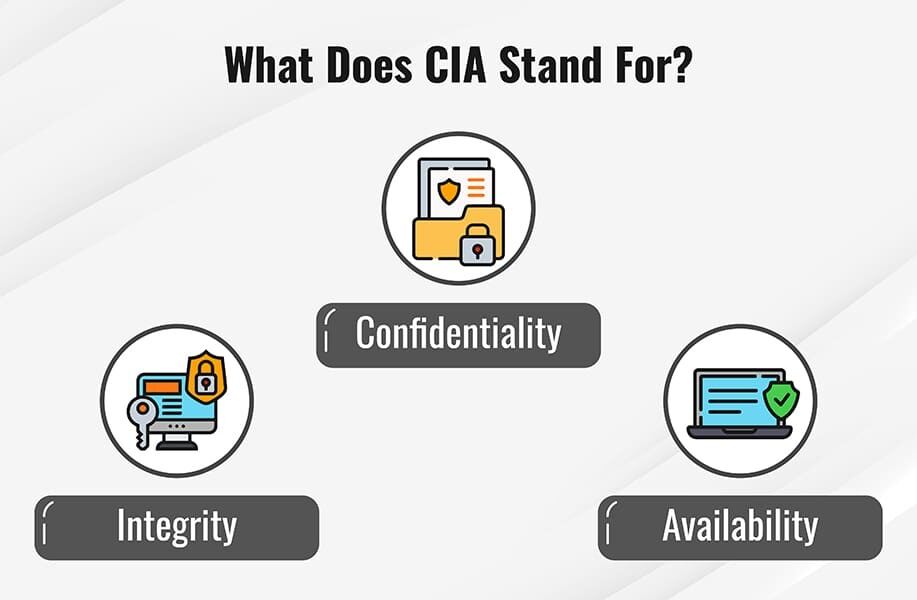

Confidentiality - Keeping data secure

Practice:
  1. Data encryption is one way to ensure confidentiality and that unauthorized users cannot retrieve data for which they do not have access.
  2. Access control is also an integral part of maintaining confidentiality by managing which users have permissions for accessing data.
  3. Life science organizations that utilize patient data must maintain confidentiality or violate HIPAA.

How:
  • Securing Data in-motion
    • Transport Channel Encryption
    • Message-level Encryption
  • Securing Data At Rest
    • Disk Level Encryption
    • File-Level Encryption

Integrity - Keeping data clean

Integrity refers to whether your data is authentic, accurate, and reliable.

Practice:
  1. Event log management within a Security Incident and Event Management system is crucial for practicing data integrity.
  2. Implementing version control and audit trails into your IT program will allow your organization to guarantee that its data is accurate and authentic.
  3. Integrity is an essential component for organizations with compliance requirements. For example, a condition of the SEC compliance requirements for financial services organizations requires providing accurate and complete information to federal regulators.
How:
  • Message Authentication Code (MAC)
  • Hash-Based Message Authentication Code (HMAC)
  • Digital Signatures
  • Message Digest

Availability - Keeping data accessible

Practice
  1. Employing a backup system and a disaster recovery plan is essential for maintaining data availability should a disaster, cyber-attack, or another threat disrupt operations.
  2. Utilizing cloud solutions for data storage is one way in which an organization can increase the availability of data for its users.
  3. As the reliance on data analytics expands, the need for data to be available and accessible grows for sectors like financial services and life sciences.
How:
  • Denial of Service (DoS)
  • Threat Modeling and use of Anomaly Detection tools
  • Resource Throttling
  • Intrusion Prevention Systems (IPS) Based Prevention
  • Network Ingress Filtering


Other principles relating to CIA

Authentication
  • MFA
  • Password-Less Authentication
  • Authentication Models (API and Web Applications) - OAuth, Federated Identity SSO
  • Active Directory (AD) Authentication
  • Active Directory Federation Services (ADFS)
  • Simple Authentication and Security Layer (SASL)

Authorization
  • Access Control Lists (ACL)
  • OASIS Extensible Control Access Markup Language (XACML)
  • Java Web Token (JWT)

Auditing
  • Non-Repudiation


Notes: https://systemweakness.com/a-brief-introduction-to-security-architecture-principles-24f5fbc58dd4


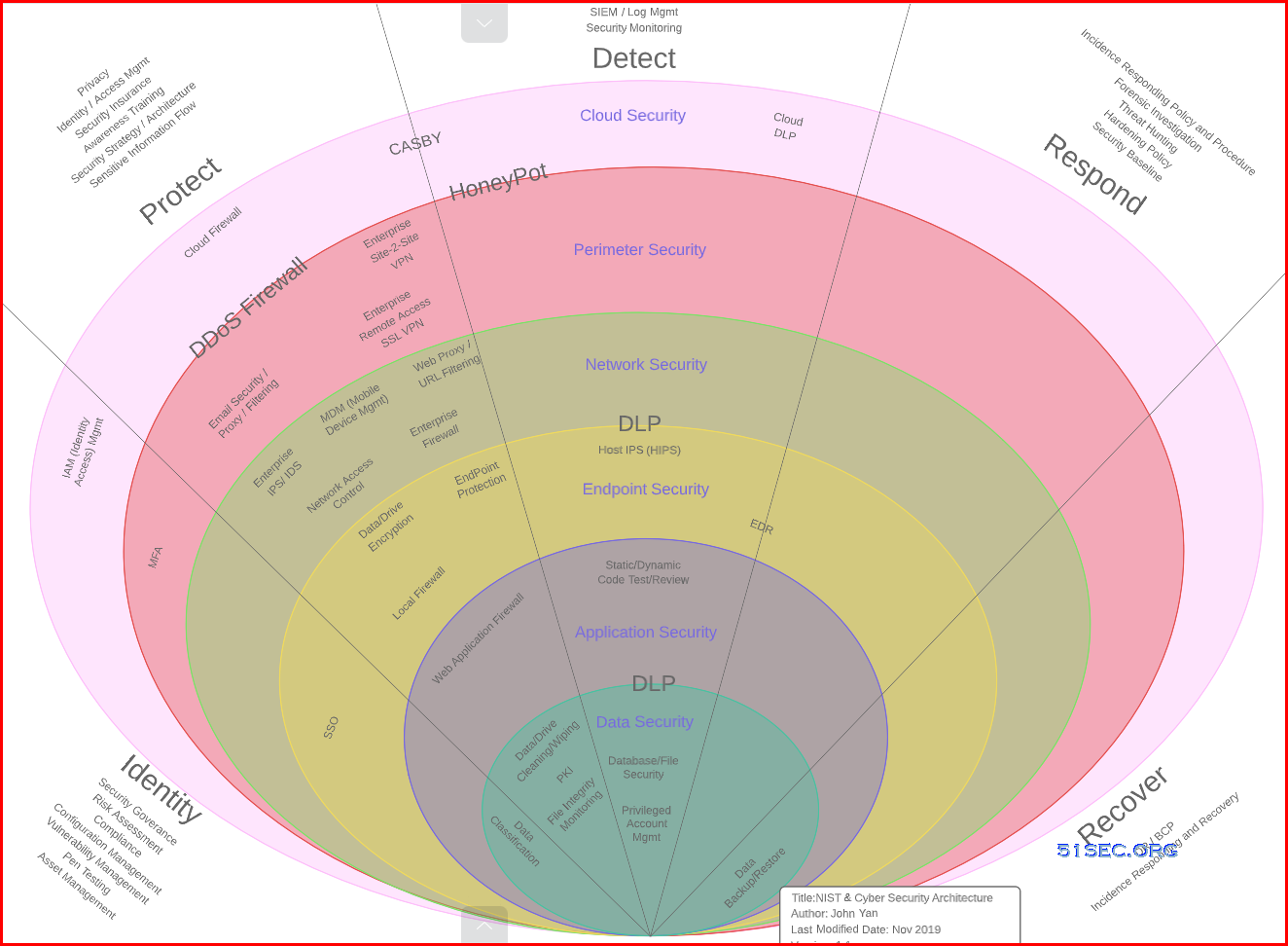
Defense-in-Depth (DiD)

Aka security in depth, refers to a cybersecurity approach that uses multiple layers of security for holistic protection. A layered defense helps security organizations reduce vulnerabilities, contain threats, and mitigate risk.
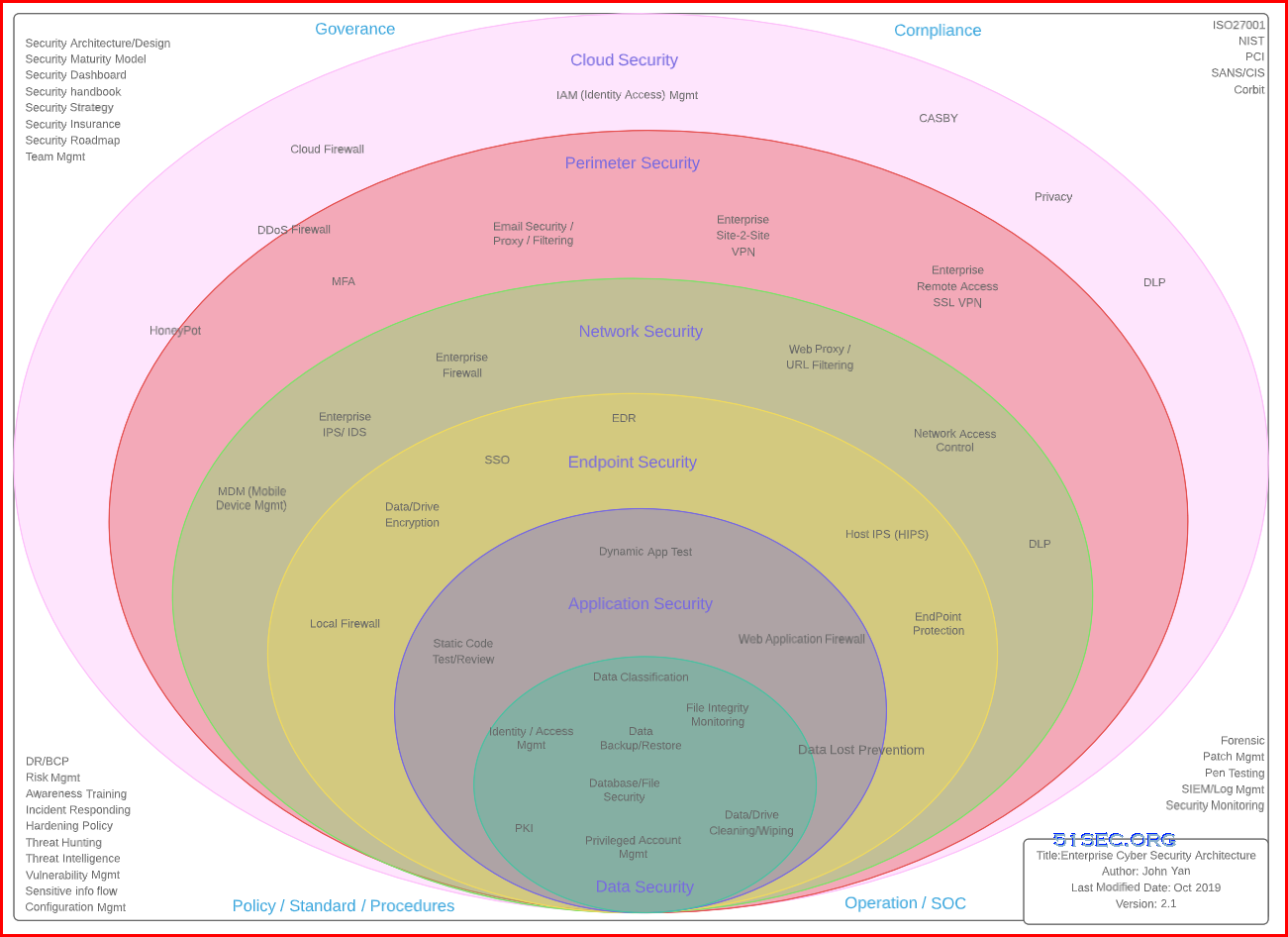

From: https://lucid.app/lucidchart/271dbc7a-e65f-43e7-a278-ee17240c77a7/edit?page=m-5o7ONTd-nK#


From: https://lucid.app/lucidchart/64441e4f-d35f-4065-92a3-a5bcf2886f8f/edit?invitationId=inv_4eec6e85-6cdc-495c-8f8e-50f3c7fc3a79

Zero Trust (Assume-Breach)

Zero Trust is a security model that emphasizes the need to verify every user and device before granting them access to company resources.

The key tenets of a modern defense-in-depth strategy include:

  • Protect privileged access – use privileged access management solutions to monitor and secure access to privileged accounts (superuser accounts, local and domain administrator accounts, application administrative accounts, etc.) by both human and non-human identities (applications, scripts, bots, etc.).
  • Lockdown critical endpoints – use advanced endpoint privilege management solutions to lock down privilege across all endpoints, prevent lateral movement, and defend against ransomware and other forms of malware.
  • Enable adaptive multifactor authentication – use contextual information (location, time of day, IP address, device type, etc.) and business rules to determine which authentication factors to apply to a particular user in a particular situation.
  • Secure developer tools – use secrets management solutions to secure, manage, rotate and monitor secrets and other credentials used by applications, automation scripts, and other non-human identities.
Solutions:
1. Threat detection and response solutions
2. Identity and privileged access management
3. Endpoint and data protection
4. Security services

Best Practices:
1. Always Verify the User with Multi-factor Authentication (MFA)
2. Always Validate the Device
3. Ensure the Device Measures Up to Your Security Standards
4. Least Access and Least Privilege for IT and Everybody Else
5. Use a Solution that Learns and Adapts


Zero Trust vs Defense in Depth

The main difference is that Zero Trust requires continuous verification of users and devices, whereas Defense in Depth relies on multiple layers of security defenses. Additionally, Zero Trust focuses on protecting data and systems from external and internal threats, while Defense in Depth mainly focuses on external threats.


Frameworks


  1. TOGAF: The Open Group Architecture Framework, or TOGAF, helps determine what problems a business wants to solve with security architecture. It focuses on the preliminary phases of security architecture, an organization's scope and goal, setting out the problems a business intends to solve with this process. However, it does not give specific guidance on how to address security issues.
  2. SABSA: Sherwood Applied Business Security Architecture, or SABSA, is a quite policy driven framework that helps define key questions that must be answered by security architecture: who, what, when and why. Its aim is to ensure that security services are designed, delivered and supported as an integral part of the enterprise's IT management. However, while often described as a 'security architecture method', it does not go into specifics regarding technical implementation


  3. OSA: Open Security Architecture, or OSA, is a framework related to functionality and technical security controls. It offers a comprehensive overview of key security issues, principles, components and concepts underlying architectural decisions that are involved when designing effective security architectures. That said, it can typically only be used once the security architecture is already designed.        

Key Deliverables:

TOGAF EXAMPLES:

  • Definition of business principles, goals and drivers.
  • Security architecture roadmaps - or in other words, a list of individual work packages that will define the target security architecture and show progression from the as-is state to the desired state within agreed timelines.
  • Security architecture building blocks. A building block is a package of functionality designed to meet the business needs across an organization.
  • Specification of security architecture requirements. This provides a quantitative view of the solution, stating measurable criteria that must be met during implementation.

SABSA EXAMPLES:

  • The business attribute model - the heart of SABSA. The business attribute model is an abstraction of real-life business requirements, detailing definitions and guidelines for a variety of important business attributes.
  • A defined security strategy, mapped to control objectives and business attribute profile.
  • Security policy architecture, which covers security and domain policies that an organization should follow, complied to the latest security standards and regulatory bodies.
  • Defined security services. These should be based on security policies, business strategies and control objectives.

OSA EXAMPLES:

  • Functionality and technical security controls. These provide a definition of technical security controls such as access controls, system hardening, security scans, etc.
  • Software and data integrity protection, a taxonomy of software integrity protection techniques
Notes: https://www.dig8ital.com/post/what-is-security-architecture-and-what-do-you-need-to-know


COBIT: 
COBIT 5, from ISACA, is “a comprehensive framework that assists enterprises in achieving their objectives for the governance and management of enterprise IT.”1 This framework includes tool sets and processes that bridge the gap between technical issues, business risk and process requirements. The goal of the COBIT 5 framework is to “create optimal value from IT by maintaining a balance between realising benefits and optimising risk levels and resource use.” COBIT 5 aligns IT with business while providing governance around it.


ISACA Top-Down Approach

Enterprise Security Architecture—A Top-down Approach


Using the Frameworks to Develop an Enterprise Security Architecture

The fair question is always, “Where should the enterprise start?”

If one looks at these frameworks, the process is quite clear. This must be a top-down approach—start by looking at the business goals, objectives and vision.

The initial steps of a simplified Agile approach to initiate an enterprise security architecture program are:

  • Identify business objectives, goals and strategy
  • Identify business attributes that are required to achieve those goals
  • Identify all the risk associated with the attributes that can prevent a business from achieving its goals
  • Identify the required controls to manage the risk
  • Define a program to design and implement those controls:
    • Define conceptual architecture for business risk:
      • Governance, policy and domain architecture
      • Operational risk management architecture
      • Information architecture
      • Certificate management architecture
      • Access control architecture
      • Incident response architecture
      • Application security architecture
      • Web services architecture
      • Communication security architecture
    • Define physical architecture and map with conceptual architecture:
      • Platform security
      • Hardware security
      • Network security
      • Operating system security
      • File security
      • Database security, practices and procedures
    • Define component architecture and map with physical architecture:
      • Security standards (e.g., US National Institute of Standards and Technology [NIST], ISO)
      • Security products and tools (e.g., antivirus [AV], virtual private network [VPN], firewall, wireless security, vulnerability scanner)
      • Web services security (e.g., HTTP/HTTPS protocol, application program interface [API], web application firewall [WAF])
    • Define operational architecture:
      • Implementation guides
      • Administrations
      • Configuration/patch management
      • Monitoring
      • Logging
      • Pen testing
      • Access management
      • Change management
      • Forensics, etc.

It is that simple. After all risk is identified and assessed, then the enterprise can start designing architecture components, such as policies, user awareness, network, applications and servers.

Figure 6 depicts the simplified Agile approach to initiate an enterprise security architecture program.

Figure 6

Using these frameworks can result in a successful security architecture that is aligned with business needs:

  • COBIT principles and enablers provide best practices and guidance on business alignment, maximum delivery and benefits.
  • The COBIT Process Assessment Model (PAM) provides a complete view of requirement processes and controls for enterprise-grade security architecture.
  • SABSA layers and framework create and define a top-down architecture for every requirement, control and process available in COBIT.
  • The TOGAF framework is useful for defining the architecture goals, benefits and vision, and setting up and implementing projects to reach those goals.
  • The CMMI model is useful for providing a level of visibility for management and the architecture board, and for reporting the maturity of the architecture over time.
Note: https://www.isaca.org/resources/isaca-journal/issues/2017/volume-4/enterprise-security-architecturea-top-down-approach

References


via Blogger http://blog.51sec.org/2022/12/cybersecurity-architect-knowledge.html
December 09, 2022 at 08:15PM Architecture
1 Comment
Identity Verification link
12/26/2022 10:27:42

Thanks for sharing such a informative blog! Choose OCR Labs due to its simple to use verification of identity technology that customers love and even comment on how easy it is to use. OCR Labs complies with the local regulations whilst offering a best in class solution to both the business and its customers.

Reply


Leave a Reply.

    Categories

    All
    Architecture
    Blog
    Checkpoint
    Cisco
    Cloud
    CyberArk
    F5
    Fortigate
    Guardium
    Juniper
    Linux
    Network
    Others
    Palo Alto
    Qualys
    Raspberry Pi
    Security
    SIEM
    Software
    Vmware
    VPN
    Wireless

    Archives

    March 2024
    February 2024
    January 2024
    December 2023
    November 2023
    October 2023
    September 2023
    August 2023
    July 2023
    June 2023
    May 2023
    April 2023
    March 2023
    February 2023
    January 2023
    December 2022
    November 2022
    October 2022
    September 2022
    August 2022
    July 2022
    June 2022
    May 2022
    April 2022
    March 2022
    February 2022
    January 2022
    December 2021
    November 2021
    October 2021
    September 2021
    August 2021
    July 2021
    June 2021
    May 2021
    April 2021
    March 2021
    February 2021
    January 2021
    December 2020
    November 2020
    October 2020
    September 2020
    August 2020
    July 2020
    October 2019
    September 2019
    June 2019
    July 2018
    May 2018
    December 2017
    August 2017
    April 2017
    March 2017
    January 2017
    December 2016
    November 2016
    October 2016
    September 2016
    August 2016
    July 2016
    June 2016
    May 2016
    April 2016
    March 2016
    February 2016
    January 2016
    December 2015
    November 2015
    October 2015
    September 2015
    August 2015
    July 2015
    June 2015
    May 2015
    April 2015
    March 2015

    Print Page:

    RSS Feed

    Email Subscribe
Powered by Create your own unique website with customizable templates.
  • Blog
  • Sitemap
    • Categories
  • Contact
  • About
  • Resources
  • Tools
  • 51sec.org
