Info Security Memo
  • Blog
  • Sitemap
    • Categories
  • Contact
  • About
  • Resources
  • Tools
  • 51sec.org

Build Confidence

Focusing on Information Security 

Info Security Notes

Industry's Fastest Firewall - SRX5800 delivers two terabits per second of throughput 

4/28/2015

0 Comments


Express Path for the SRX5000 line


Just Announced: Industry's Fastest Firewall - SRX5800 delivers two terabits per second of throughput  


The first of its kind, the SRX data center firewall delivers the highest known performance on a single chassis with as low as 7 microseconds latency and 2 Tbps* performance — perfect for environments where security must operate at the speed of the network.


Reference: http://www.juniper.net/us/en/dm/bettersecurity/


0 Comments

Set Up IPSec Site to Site VPN Between Fortigate 60D (4) - SSL VPN

4/22/2015

1 Comment

 
IPSec Site to Site VPN Configuration Series:
  1. Set Up IPSec Site to Site VPN Between Fortigate 60D (1) - Route-Based VPNs
  2. Set Up IPSec Site to Site VPN Between Fortigate 60D (2) - Policy-Based VPNs
  3. Set Up IPSec Site to Site VPN Between Fortigate 60D (3) - Concentrator and Troubleshooting
  4. Set Up IPSec Site to Site VPN Between Fortigate 60D (4) - SSL VPN
SSL VPNs establish connectivity using SSL, which functions at Levels 4 - 5 (Transport and Session layers). Information is encapsulated at Levels 6 - 7 (Presentation and Application layers), and SSL VPNs communicate at the highest levels in the OSI model. SSL is not strictly a Virtual Private Network (VPN) technology that allows clients to connect to remote networks in a secure way.

FortiOS supports the SSL (not SSL1.0) and TLS (TLS1.3) versions defined below:

Defined
Protocol Year
SSL 1.0 n/a
SSL 2.0 1995 - RFC 6176
SSL 3.0 1996 - RFC 6101
TLS 1.0 1999 - RFC 2246
TLS 1.1 2006 - RFC 4346
TLS 1.2 2008 - RFC 5246
TLS 1.3 TBD


When a remote client connects to the FortiGate unit, the FortiGate unit authenticates the user based on username, password, and authentication domain. A successful login determines the access rights of remote users according to user group. The user group settings specify whether the connection will operate in web-only mode or tunnel mode. There are three types of mode:

  1. Web-only Mode
  2. Tunnel Mode
  3. Port Forwarding Mode (Proxy Mode)


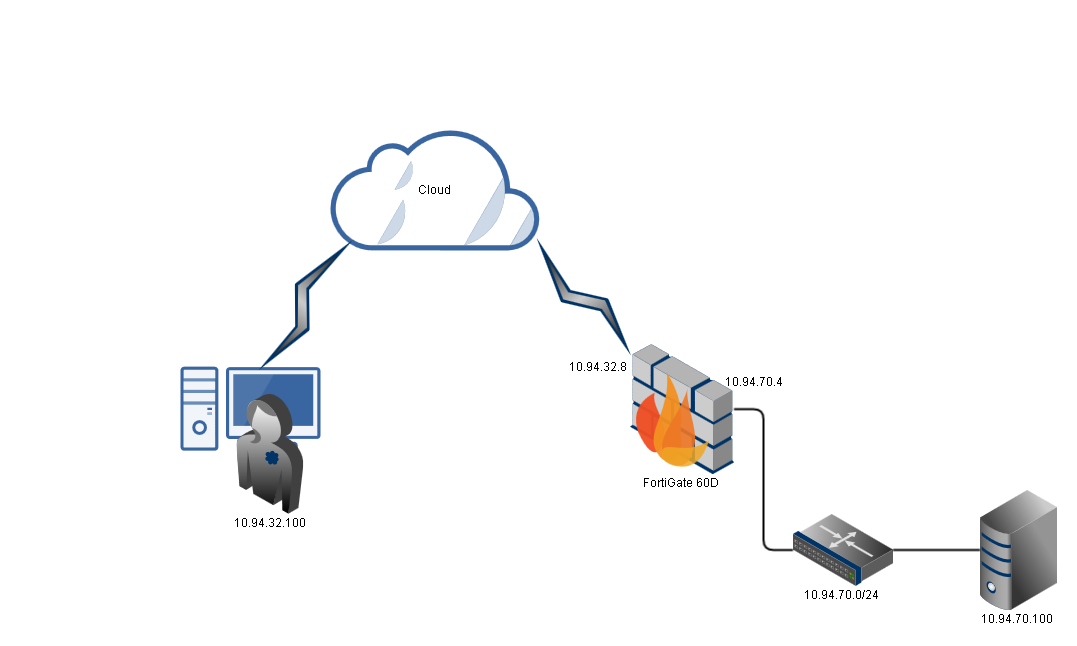
 Lab Topology:


Configuration Steps:

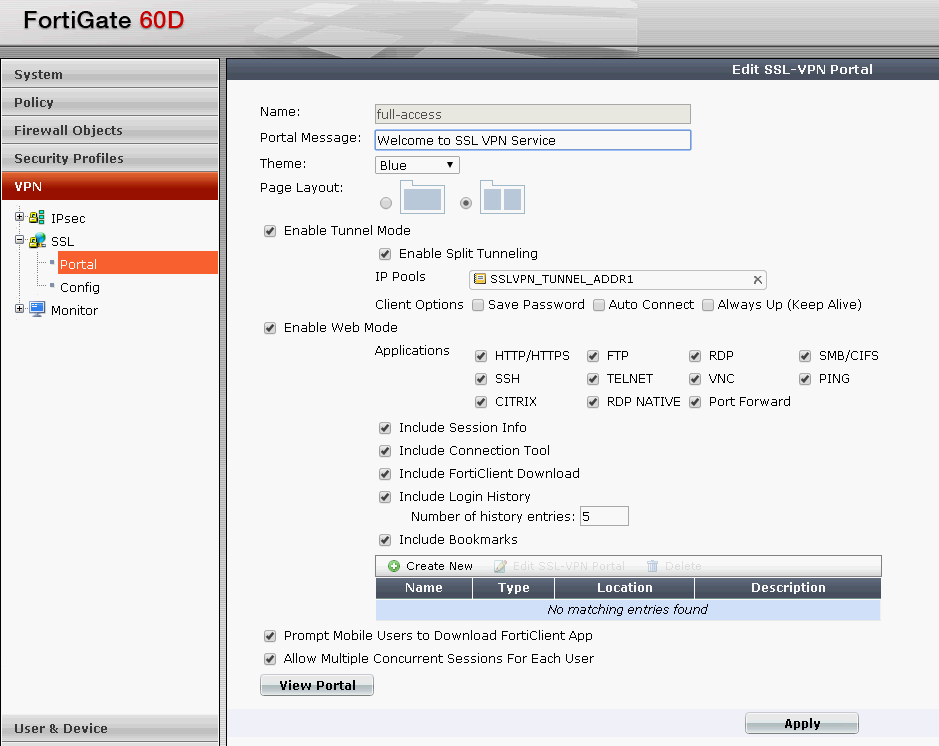
1. Create SSL VPN Portal


 2. Create Remote Users and Groups


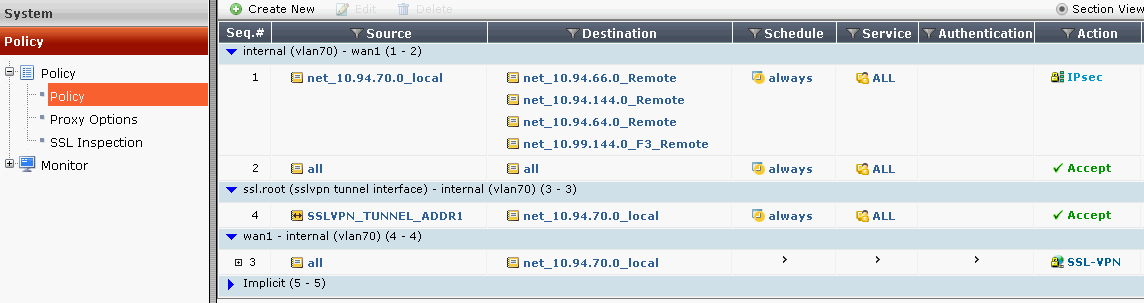
3. Create Security Policies

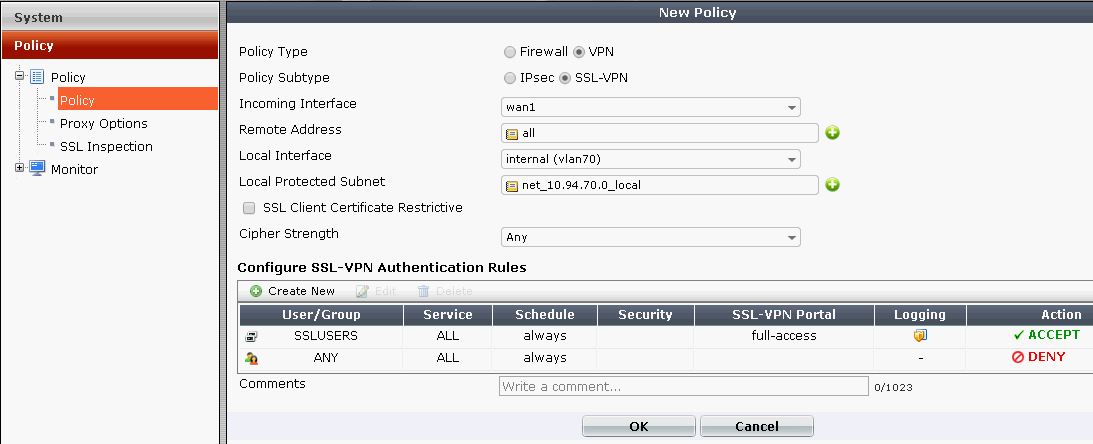
 3.1 SSL-VPN Rule from WAN1 to Internal

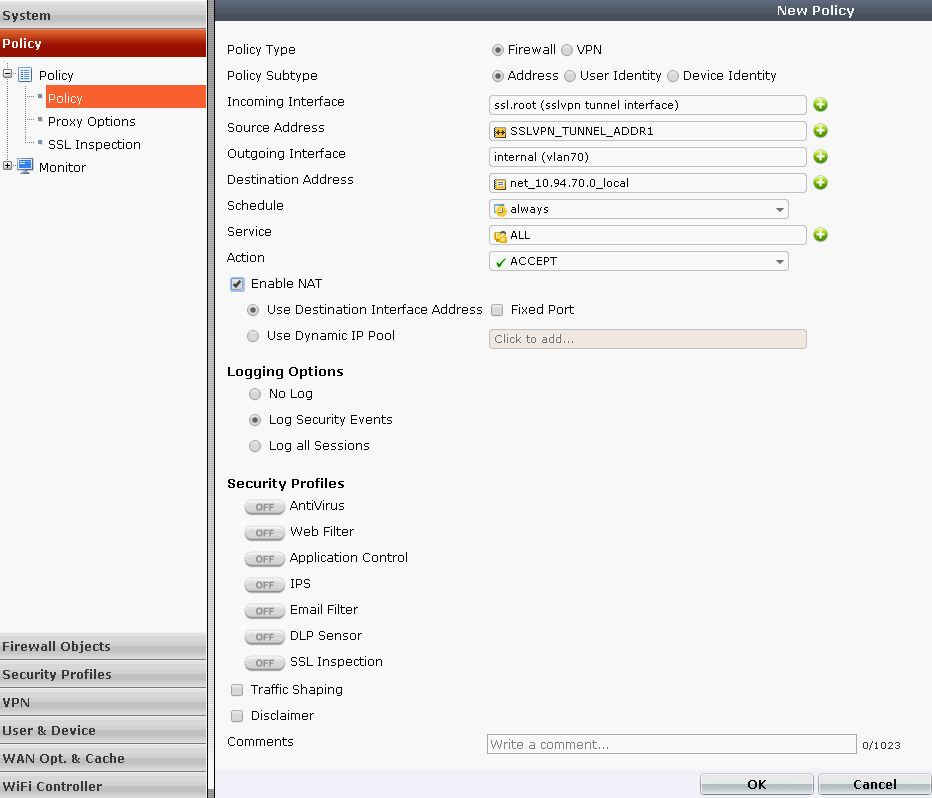
 3.2 Firewall Address Policy from SSL Tunnel Address to Internal


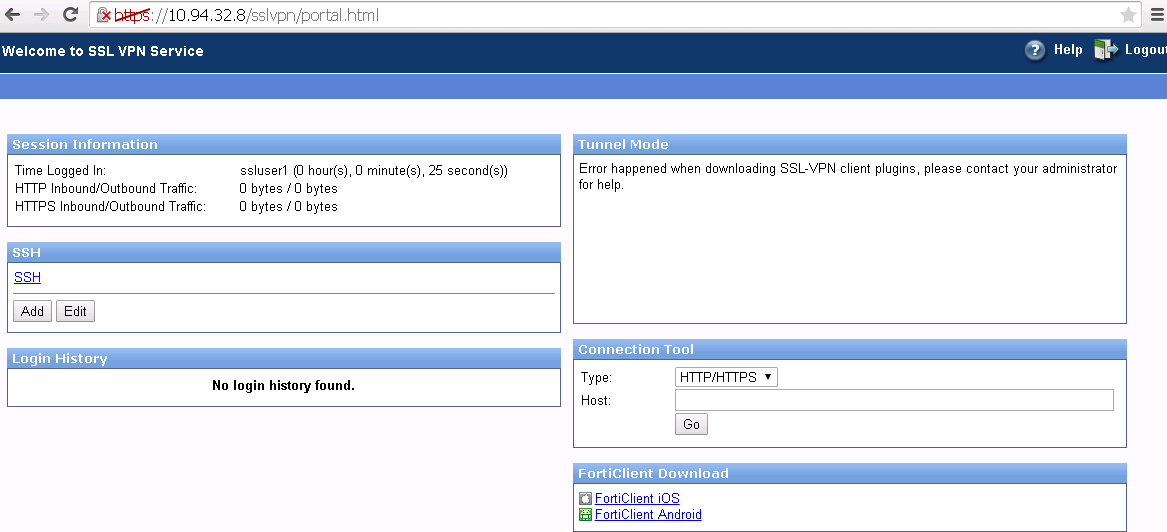
 4. Test


Reference:

  1. FortiOS™ Handbook - SSL VPN (VERSION 5.2.2)
  2. How to setup SSL VPN (Web & Tunnel mode) for remote access
  3. Chapter 16 SSL VPN for FortiOS 5.0
  4. Setup examples : Remote Access with SSLVPN


1 Comment

Set Up IPSec Site to Site VPN Between Fortigate 60D (3) - Concentrator and Troubleshooting

4/15/2015

0 Comments

 
Set Up IPSec Site to Site VPN Between Fortigate 60D (1) - Route-Based VPNs
Set Up IPSec Site to Site VPN Between Fortigate 60D (2) - Policy-Based VPNs
Set Up IPSec Site to Site VPN Between Fortigate 60D (3) - Concentrator and Troubleshooting

After tested policy based and route based IPSec vpn, this post will do a quick test FortiGate concentrator feature.

The VPN concentrator collects hub-and-spoke tunnels into a group.The concentrator allows VPN traffic to pass from one tunnel to the other through the FortiGate unit. The FortiGate unit functions as a concentrator, or hub, in a hub-and-spoke network.

If the VPN peer is a FortiGate unit functioning as the hub, or concentrator, it requires aVPN configuration connecting it to each spoke (AutoIKE phase 1 and 2 settings ormanual key settings, plus encrypt policies). It also requires a concentratorconfiguration that groups the hub-and-spoke tunnels together. The concentratorconfiguration defines the FortiGate unit as the hub in a hub-and-spoke network.If the VPN peer is one of the spokes, it requires a tunnel connecting it to the hub (butnot to the other spokes). It also requires policies that control its encrypted connectionsto the other spokes and its non-encrypted connections to other networks, such as theInternet.

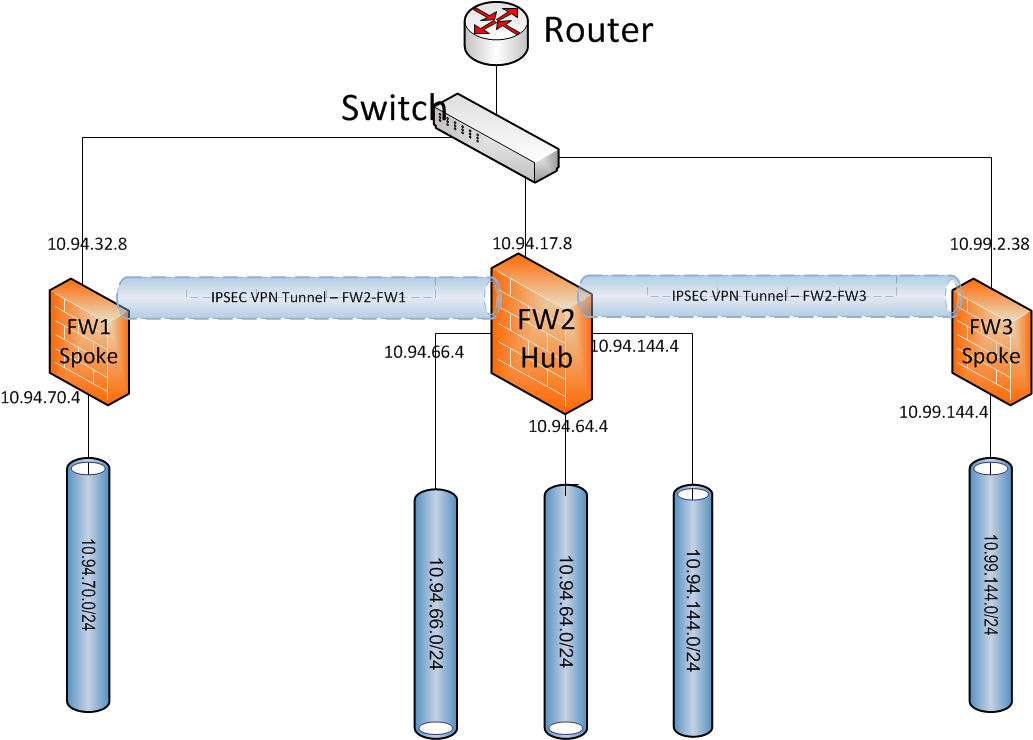
Topology:

FW3 adds into the our previous topology used in route based and policy based vpn labs. FW3 will act as another spoke , same as FW1. FW2 will be the hub , or concentrator.

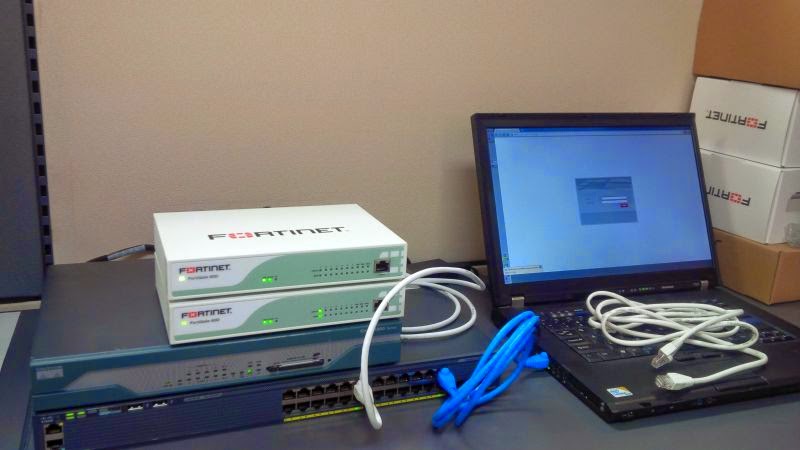
Photos:


Configuration:

1. @F3:  Since there is a vpn tunnel built between F1 and F2 from previous lab, the first step is going to build another vpn tunnel between F2 and F3.

Create all local address object and remote address objects. Remote objects will include the protected network by F1 and F2.

Create a new rule to allow local network to remote networks with a new ipsec vpn tunnel. 
Promote the new rule to the top of the list:

2. @F2. Create new policy rules with a new vpn tunnel betwee F2 and F3.

Create new remote network for F3.
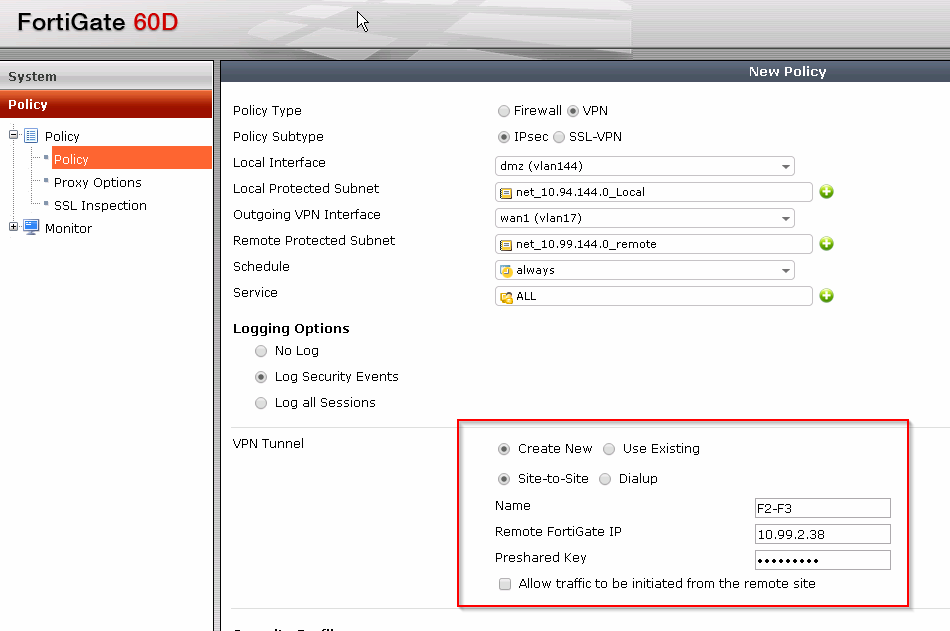
Create a couple of new rules to allow local network to access remote F3's network using a new VPN tunnel F2-F3.
Since there are three local networks behind F2, three new rules will be created. 
Note: There is no need to create rule to allow spoke traffic passing among them. 

In the VPN - IPSec - Auto Key (IKE), F2-F3 vpn tunnle profile will be there. 

At this moment, the tunnel between F2 and F3 is configured and should be up from IPSec monitoring tab.

3. Configure F1 for the traffic between two spokes , F1 and F3.

Add F3's protected network into Firewall Objects - Address - Addresses:


Add the new address object into firewall policy rule:


4. Configure concentrator on F2 hub

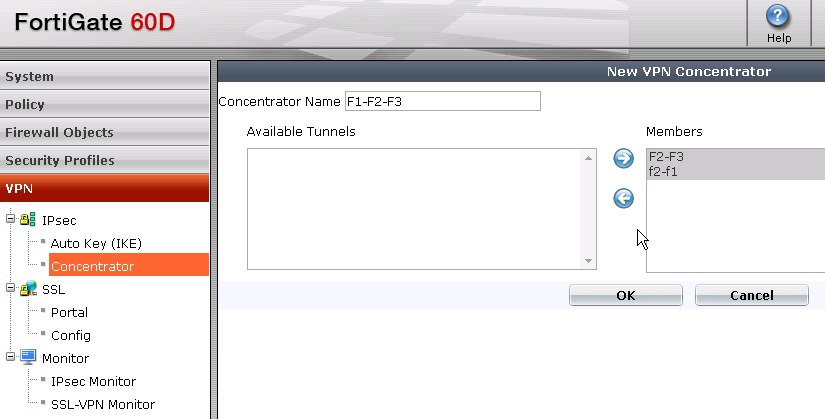
Create a new Conentrator from VPN- IPSec - Concentrator.
Give F1-F2-F3 as the name, and select both hub-spoke vpn tunnel as the members:


5. Ping Test:

This is the test from F1's local network host 10.94.70.20. Before concentrator configured at F2, ping to 10.99.144.4 timed out.

As soon as Step 4's concentrator configuration done, ping immediately replied.


Troubleshooting Commands:


FGT60D # diagnose vpn tunnel stat
dev=0 tunnel=1 proxyid=1 sa=1 conc=0 up=1

FGT60D # diagnose vpn tunnel list
list all ipsec tunnel in vd 0
------------------------------------------------------
name=f1-f2 ver=1 serial=3 10.94.32.8:0->10.94.17.8:0 lgwy=static tun=tunnel mode                                                                                           =auto bound_if=5
proxyid_num=1 child_num=0 refcnt=8 ilast=3 olast=3
stat: rxp=8 txp=12 rxb=600 txb=720
dpd: mode=active on=1 idle=5000ms retry=3 count=0 seqno=16517
natt: mode=none draft=0 interval=0 remote_port=0
proxyid=_f1-f2_tun_ proto=0 sa=1 ref=2 auto_negotiate=1 serial=1
  src: 0:0.0.0.0/0.0.0.0:0
  dst: 0:0.0.0.0/0.0.0.0:0
  SA: ref=6 options=0000002f type=00 soft=0 mtu=1412 expire=399 replaywin=1024 s                                                                                           eqno=3
  life: type=01 bytes=0/0 timeout=1777/1800
  dec: spi=1935da05 esp=aes key=32 aa7f520b5457bc16f97c5cfc43483eb1c9b54f853def0                                                                                           8213ca068506f9cb103
       ah=sha1 key=20 b69c401862a7b6320d92e36b0d400f95320852a9
  enc: spi=7b5dfde9 esp=aes key=32 0dbcde0df85b6d31dfdceded16314ff1a4ef9977e8fdb                                                                                           bed655ee9ddd0ccc80c
       ah=sha1 key=20 f6543bd37cfcbd5ccf881340f4b651940b34684d
  dec:pkts/bytes=1/60, enc:pkts/bytes=2/240
  npu_flag=03 npu_rgwy=10.94.17.8 npu_lgwy=10.94.32.8 npu_selid=3


FGT60D # diag debug application ike 255

FGT60D # diag debug enable

FGT60D # diaike 0: comes 10.94.32.8:500->10.94.17.8:500,ifindex=5....
ike 0: IKEv1 exchange=Informational id=da8b0eb3b674cd8e/c0b55e04f98318f5:ca3cf88                                                                                           1 len=92
ike 0: in DA8B0EB3B674CD8EC0B55E04F98318F508100501CA3CF8810000005C85114C19CFD9A0                                                                                           E3ECE0331A8A6134E1424AD7F8D516523A8D3421F260A17EFFAC75CD4FE3A283CD02832C07B5636B                                                                                           832E8E976E26A2376FA50F77D94B3D7620
ike 0:f2-f1:104: dec DA8B0EB3B674CD8EC0B55E04F98318F508100501CA3CF8810000005C0B0                                                                                           00018A23349616A88AF99FFEB71BDB181733E48597075000000200000000101108D28DA8B0EB3B67                                                                                           4CD8EC0B55E04F98318F5000040B28799820191C3D307
ike 0:f2-f1:104: notify msg received: R-U-THERE
ike 0:f2-f1:104: enc DA8B0EB3B674CD8EC0B55E04F98318F5081005013FB65E04000000540B0                                                                                           00018A3902503765FF73A4AEB0F8D8DBCCC04A0E1BD63000000200000000101108D29DA8B0EB3B67                                                                                           4CD8EC0B55E04F98318F5000040B2
ike 0:f2-f1:104: out DA8B0EB3B674CD8EC0B55E04F98318F5081005013FB65E040000005C7E1                                                                                           54F5BEE4DEB627A700A84B0CB3C0098B5962BFA6CED080EAC0B5BF0E406D2ED7C4EC054B05F97A20                                                                                           4A1B812D946597958233BBBA2D5CB7A2ABA6EFB70B6CE
ike 0:f2-f1:104: sent IKE msg (R-U-THERE-ACK): 10.94.17.8:500->10.94.32.8:500, l                                                                                           en=92, id=da8b0eb3b674cd8e/c0b55e04f98318f5:3fb65e04
ike 0:f2-f1: link is idle 5 10.94.17.8->10.94.32.8:0 dpd=1 seqno=40ac
ike 0: comes 10.94.32.8:500->10.94.17.8:500,ifindex=5....
ike 0: IKEv1 exchange=Informational id=da8b0eb3b674cd8e/c0b55e04f98318f5:60b967f2 len=92
ike 0: in DA8B0EB3B674CD8EC0B55E04F98318F50810050160B967F20000005CB93CFF645F24AAD1702B89F758E4691C3A67210427BB251023BD3137C605D21D55585C435F25627A09A6242A5C4280EFA4B40E37AEF95224E33308D50465F0F9
ike 0:f2-f1:104: dec DA8B0EB3B674CD8EC0B55E04F98318F50810050160B967F20000005C0B000018F7DB4421DE4D8FE837A092498CC9FC19144E120D000000200000000101108D28DA8B0EB3B674CD8EC0B55E04F98318F5000040B30821732F98702307
ike 0:f2-f1:104: notify msg received: R-U-THERE
ike 0:f2-f1:104: enc DA8B0EB3B674CD8EC0B55E04F98318F508100501C910E3AF000000540B0000189A4BC0E8ACAAD4C3336B442280051149189B1574000000200000000101108D29DA8B0EB3B674CD8EC0B55E04F98318F5000040B3
ike 0:f2-f1:104: out DA8B0EB3B674CD8EC0B55E04F98318F508100501C910E3AF0000005CEC41A52E04D7316299F3DBCE4005D26AE26AFE40F3ADA9ADBF24652041B6836EB942D004846F1B61F528980E9E3B9811CB6AC66B6C6DE439DF98CBC247BA4206
ike 0:f2-f1:104: sent IKE msg (R-U-THERE-ACK): 10.94.17.8:500->10.94.32.8:500, len=92, id=da8b0eb3b674cd8e/c0b55e04f98318f5:c910e3af
ike 0:f2-f1: link is idle 5 10.94.17.8->10.94.32.8:0 dpd=1 seqno=40ad
ike shrank heap by 122880 bytes
ike 0: comes 10.94.32.8:500->10.94.17.8:500,ifindex=5....
ike 0: IKEv1 exchange=Informational id=da8b0eb3b674cd8e/c0b55e04f98318f5:60199215 len=92
ike 0: in DA8B0EB3B674CD8EC0B55E04F98318F508100501601992150000005C202E2B7EC4FD78A9A47A7BAADC85BBBA1240E38168A3E1FF37450B96DA085B38096EFC3352AF7D457DF3D66674BA6848093BFD670234A7E9AC32297AF7A35F73
ike 0:f2-f1:104: dec DA8B0EB3B674CD8EC0B55E04F98318F508100501601992150000005C0B0000188389BC2895680F8618F031B82FB9DA3FEB9C6769000000200000000101108D28DA8B0EB3B674CD8EC0B55E04F98318F5000040B4B478A703A2351A07
ike 0:f2-f1:104: notify msg received: R-U-THERE
ike 0:f2-f1:104: enc DA8B0EB3B674CD8EC0B55E04F98318F5081005013AB0F2D6000000540B0000182AAE9F0D1D6178FF2826ABD38FCE35A17107CD42000000200000000101108D29DA8B0EB3B674CD8EC0B55E04F98318F5000040B4
ike 0:f2-f1:104: out DA8B0EB3B674CD8EC0B55E04F98318F5081005013AB0F2D60000005C84CD92EF75CD2D72941E654D9C1F27D43038A5D56287736BABF6232A5744E413A2A4AC5FFEEA28AA1A51FAD159536748874E6D7F692750CC060C9619E727DD25
ike 0:f2-f1:104: sent IKE msg (R-U-THERE-ACK): 10.94.17.8:500->10.94.32.8:500, len=92, id=da8b0eb3b674cd8e/c0b55e04f98318f5:3ab0f2d6
ike 0:f2-f1: link is idle 5 10.94.17.8->10.94.32.8:0 dpd=1 seqno=40ae

FGT60D # diag debug reset

FGT60D # diag debug disable


Reference:

  • Fortinet FortiGate 50A Configuration Manual: Vpn Concentrator (hub) General Configuration Steps
0 Comments

Set Up IPSec Site to Site VPN Between Fortigate 60D (2) - Policy-Based VPNs

4/14/2015

0 Comments

 
This is the second post for Fortigate IPSec VPN configuration. It will use same topology as previous one.

The implementation will be set up policy based IPSec VPN between two sites.

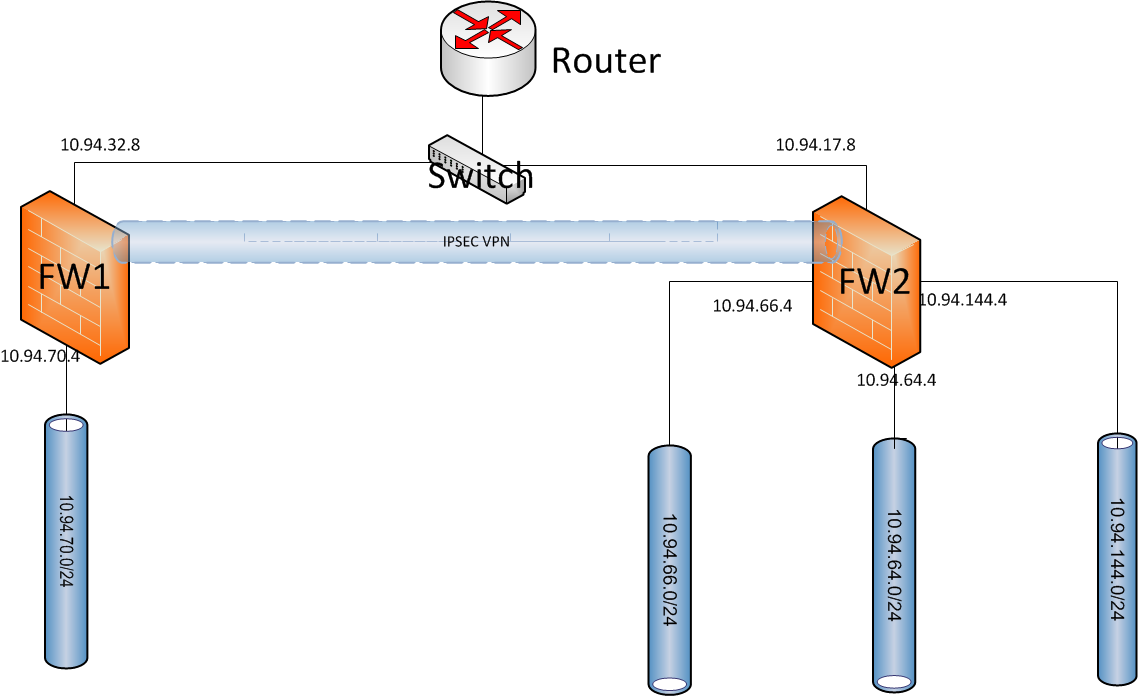
Topology:


Configuration Steps:

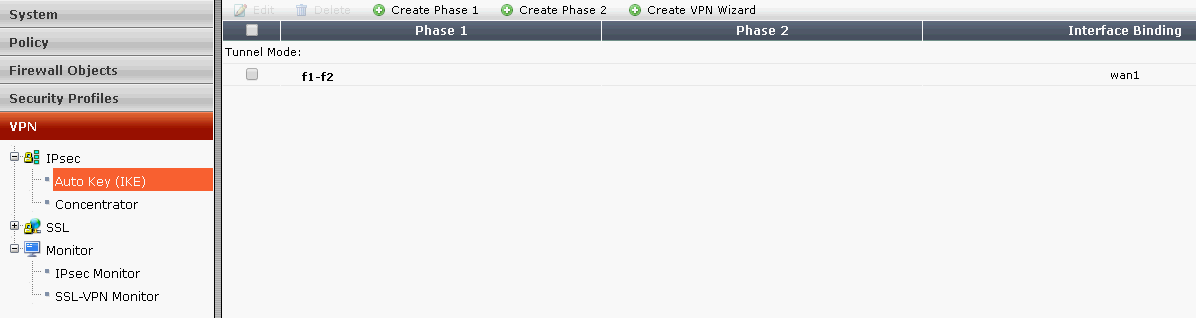
1. Enable Policy Based VPN feature:

By default, Policy-Based IPSec VPN feature is not enabled.  We will have to go to System-Config-Feature-Show More to enable it.

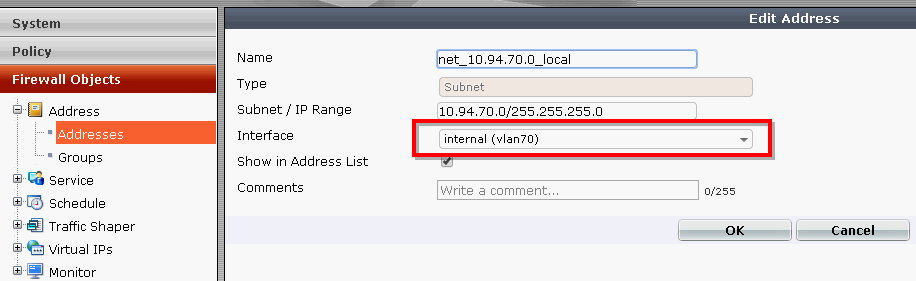
2. Go to: Firewall Objects > Address > Address


  • Create New Address – Internal Subnet - Name it as net_10.94.70.0_local
  • Enter local subnet: 10.94.70.0/24
  • Select internal interface

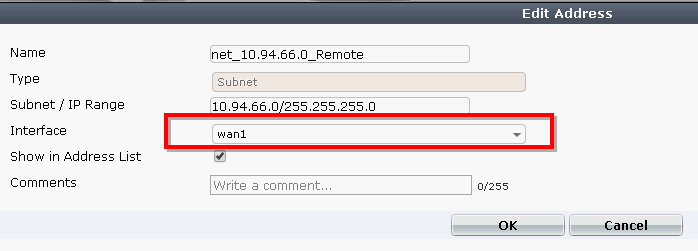
3. Create New Address – Remote Subnet - Name it as net_10.94.66.0_Remote


  • Enter Remote Subnet: 10.94.66.0/24
  • Enter wan1 Interface


4.  Go to Policy > Policy > Policy

  • Create New
  • Select VPN Policy Type
  • Select IPsec Subtype
  • Select the local interface - internal, and Local Protected Subnet net_10.94.70.0_local
  • Select the wan interface - wan1, and remote protected Subnet net_10.94.66.0_remote
  • Set service to all
  • Select create new VPN Tunnel.
  • Choose Site-to-Site and Name it as f1-f2
  • Put FW2's wan1 ip 10.94.17.8 as Remote FortiGate IP.
  • Enter Preshared Key
  • Check the box to allow traffic to be initiated from the remote site
Note: If you choose use Existing directly, sometimes, you will not see your pre-configured VPN tunnel in the list. Create a new vpn tunnel from here always works.

5. Move the policy to the top of the list

6. FW2's Configuration

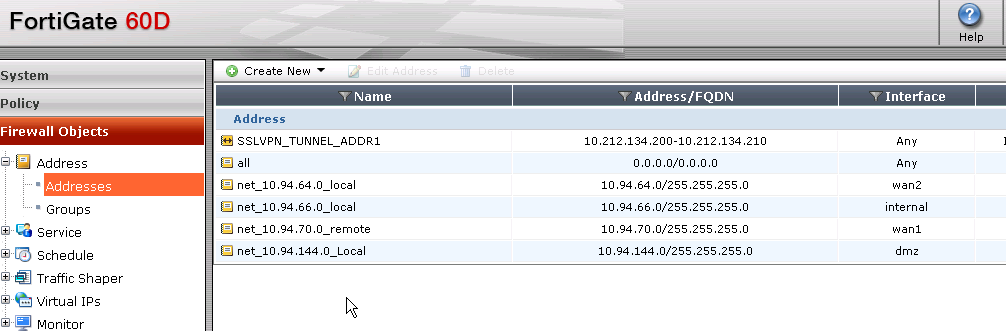
a. FW2's Firewall Objects - Address-Addresses
There are three local networks defined in here, including all local subnets 10.94.64.0/24, 10.94.66.0/24 and 10.94.144.0/24
 b. Three policy rules defined for three different local networks. Remote destination network are same, which is 10.94.70.0/24. All those three rules are using same IPSec vpn tunnle f2-f1, which is defined in step 4.

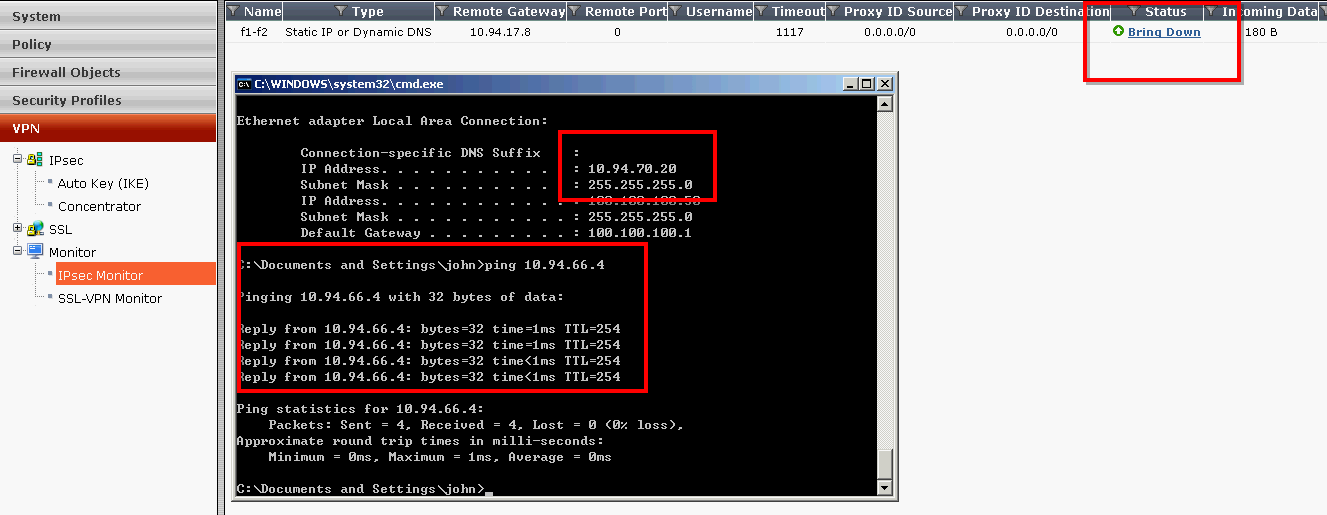
7. Verify VPN Configuration and Monitoring VPN Tunnel

 Note: There is no phase 2 in the Auto Key (IKE) configuration.
Verified ping from 10.94.70.20 to 10.94.66.4

Reference:

  • Using policy-based IPsec VPN for communication between offices


0 Comments

Set Up IPSec Site to Site VPN Between Fortigate 60D (1) - Route-Based VPNs

4/13/2015

0 Comments

 
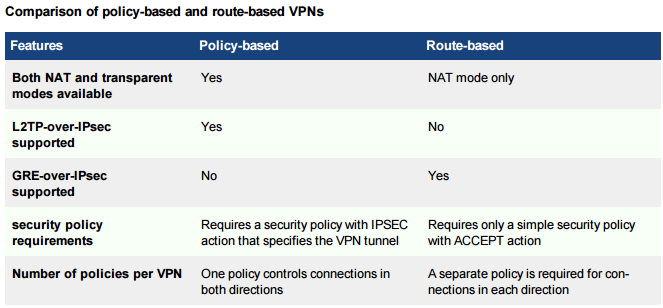
Fortigate firewall supports two types of site-to-site IPSec vpn based on FortiOS Handbook 5.2,  policy-based or route-based. There is little difference between the two types. However there is a difference in implementation. A route-based VPN creates a virtual IPsec network interface that applies encryption or decryption as needed to any traffic that it carries.That is why route-based VPNs are also known as interface-based VPNs. A policy-based VPN is implemented through a special security policy that applies the encryption you specified in the Phase 1 and Phase 2 settings.

Route-based VPNs:
For a route-based VPN, you create two security policies between the virtual IPsec interface and the interface that connects to the private network. In one policy the virtual interface is the source. In the other policy the virtual interface is the destination. The Action for both policies is Accept. This creates bidirectional policies that ensure traffic will flow in both directions over the VPN.

Policy-based VPNs:
For a policy-based VPN, one security policy enables communication in both directions. You must select IPSEC as the Action and then select the VPN tunnel you defined in the Phase 1 settings. You can then enable inbound and outbound traffic as needed within that policy, or create multiple policies of this type to handle different types of traffic differently. For example HTTPS traffic may not require the same level of scanning as FTP traffic.


In this lab part 1, Route-Based VPNs will be configured between FW1 and FW2.

Topology:

1. Two Fortigate 60Ds - FW1 and FW2
2. Switch and Router for routing and connections
3. FW1 has WAN1 IP 10.94.32.8/24, Internal IP 10.94.70.4/24
4. FW2 has WAN1 IP 10.94.17.8/24, Internal IP 10.94.66.4/24, WAN2 IP 10.94.64.4/24, DMZ IP 10.94.144.4/24


Object:

Build IPSec Tunnel between FW1 and FW2 for traffic between FW1's Internal network 10.94.70.0/24 and FW2's three internal networks (10.94.66.0/24, 10.94.64.0/24, 10.94.144.0)

Devices:


Basic Configuration:


@FW1:
FW2's configuration steps are exactly same as FW1.

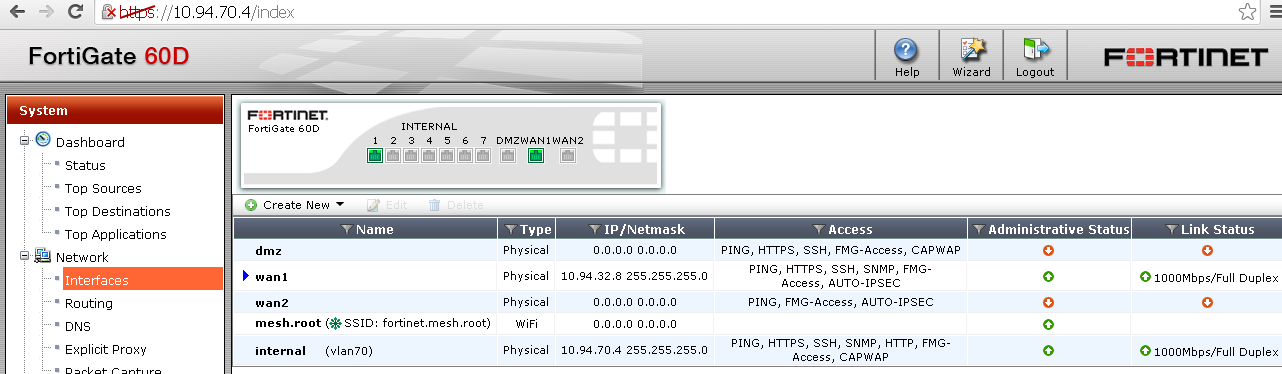
a. Interface Configuration:

wan1: 10.94.32.4/24
internal: 10.94.70.4/24

b. VPN-IPsec-Auto Key (IKE) 

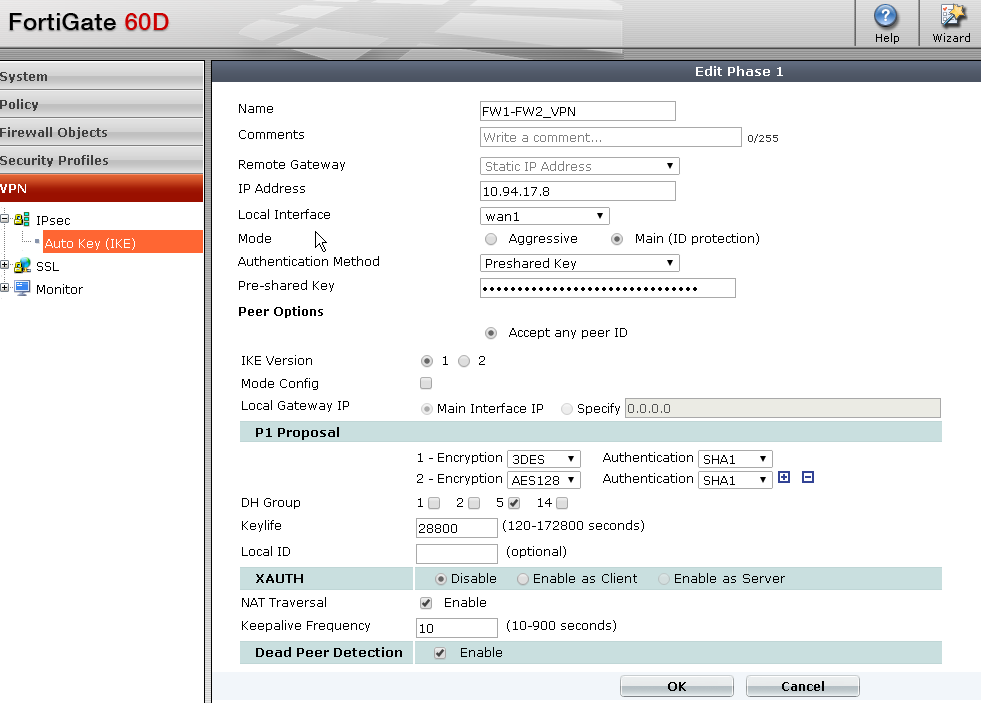
Create new Phase 1:

Note: Local Interface is wan1, not internal. Most configuration is by default. Phase1 policy name is FW1-FW2_VPN, which will be used as Interface name for IPSec Traffic later.
Create new Phase 2:
Note: You do not have to specify source / destination address.

c. Creating local and remote network address (interesting traffic to be protected by IPSec VPN)


Note: Remote network segment is on IPSec Interface. This step has to be done before creating firewall policy. Else you will get the entry is being used error when you put FW1-FW2_VPN on the Interface.

d. create two firewall rules in the policy:

One is from Internal network segment to Remote network. Another one is from Remote network to Internal network. Please keep priority of the rule order in mind. You may need to manual adjust your rule order. Usually IPSec Traffic will be put on top of other rules, except management rule.


e. Create Route for Interesting traffic:

The remote network segment will be routed to IPSec Interface FW1-FW2_VPN

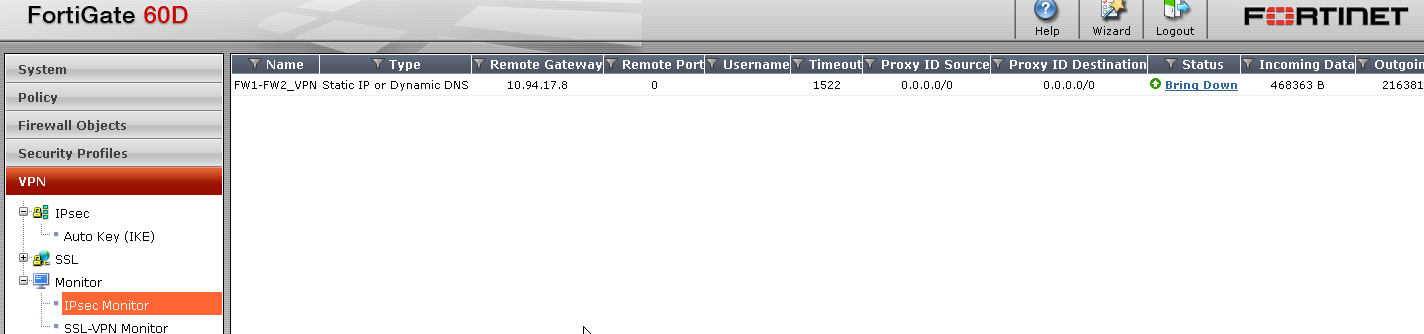
f. Monitor IPSec Tunnel:


Reference:


  • FortiOS Handbook - IPsec VPN for FortiOS 5.2
  • Setup Site-to-Site IPSec VPN (Basic) (Youtube)


0 Comments

    Categories

    All
    Architecture
    Blog
    Checkpoint
    Cisco
    Cloud
    CyberArk
    F5
    Fortigate
    Guardium
    Juniper
    Linux
    Network
    Others
    Palo Alto
    Qualys
    Raspberry Pi
    Security
    SIEM
    Software
    Vmware
    VPN
    Wireless

    Archives

    March 2024
    February 2024
    January 2024
    December 2023
    November 2023
    October 2023
    September 2023
    August 2023
    July 2023
    June 2023
    May 2023
    April 2023
    March 2023
    February 2023
    January 2023
    December 2022
    November 2022
    October 2022
    September 2022
    August 2022
    July 2022
    June 2022
    May 2022
    April 2022
    March 2022
    February 2022
    January 2022
    December 2021
    November 2021
    October 2021
    September 2021
    August 2021
    July 2021
    June 2021
    May 2021
    April 2021
    March 2021
    February 2021
    January 2021
    December 2020
    November 2020
    October 2020
    September 2020
    August 2020
    July 2020
    October 2019
    September 2019
    June 2019
    July 2018
    May 2018
    December 2017
    August 2017
    April 2017
    March 2017
    January 2017
    December 2016
    November 2016
    October 2016
    September 2016
    August 2016
    July 2016
    June 2016
    May 2016
    April 2016
    March 2016
    February 2016
    January 2016
    December 2015
    November 2015
    October 2015
    September 2015
    August 2015
    July 2015
    June 2015
    May 2015
    April 2015
    March 2015

    Print Page:

    RSS Feed

    Email Subscribe
Powered by Create your own unique website with customizable templates.
  • Blog
  • Sitemap
    • Categories
  • Contact
  • About
  • Resources
  • Tools
  • 51sec.org